

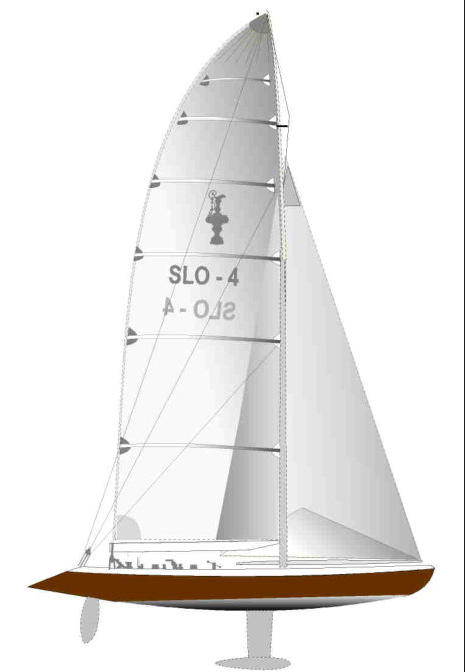
SLO-4 , der America’s Cupper aus Mahagoni, der niemals zu Wasser
gelassen wurde, aber am Schluß mit Tonnen von Regenwasser
gefült war.
Nur eine handvoll von Bildern wurden publiziert,
die ihren Rumpf aus Mahagoni und der weissen
c.K.Urtz 2012



WELCOME

AMERICA’ S CUP HISTORY 1983 - 2013


A short translation of my business friend Drazen Servis you will find below.
This is an interview with Neno Kovacevic, shipbuilding engineer. In Spring 1989, in Zgornji Velki, Steiermark,
Ljubo Versic and Bojan Butolen founded Transoceansko regatno druätvo Yacoma" with the idea to join AC. In
August they took as a partner N. Kovacevic and discussed with him the possibility to build a ship according to the AC
rules.ln Autumn 1989 all possible participants had first meeting in premises of International sailing Union IYRU
(now ISAF) in London. They agreed that 4 or 5 "syndicates" will have one representative and with Slovenians were
Spaniards, French, Germans and Fins. Germans and Fins gave up even before Slovenians. Slovenians had the best
cooperation with Japanese and Italian "syndicate". Japanese gave them one of their carbon masts for symbolic price of
USD 1 .With Italians they discussed construction details, especially with famous constructor German Frers and saw
Italian ship "II moro di Venezia" Italians at that time had the biggest budget (120 mil USD) and built several ships.
Slovenian plan was to build 2 ships: one wooden for crew training and, if everything were OK, it would be used as
model for a second made of carbon. First ship was completely built in Zgornji Velki but second one was never finished.
As far as other equipment was concerned, everything was ready. earlier mentioned Japanese mast was in States, all
deck equipment was bought and sails were agreed with other "syndicates". After Germans gave up, as a potential
Sponsor appeared BASF ready to invest quite some money. Problem was that all financial transaction went through
Belgrade and at that time political crises already started and that's why ship was transferred to Italy, so money
went directly to Italy. Second reason was that they started to cooperate with Mr. Cantoni, owner of Italian shipbuilding
Company Vector Marine. lt was just by Chance; they wanted already to give up and went to meeting in Nice to
announce that, but on the way they visited Raul Gardini, boss of Italian team. He mentioned that Cantoni is producing
20 m motor boats and wants them to be used äs a judge boats on AC race. So, he wanted to cooperate with one of
"syndicate" to be included in AC events. Gardini was not interested and that is how Slovenians sorted their project. So,
in September 1991 they moved ship to shipyard near Venice. They covered it with furnir and prepared a lot of
equipment. Transport to States was settled and it would be paid by Gardini, what is one more proof about good
cooperation between teams. Despite all that they ran out of time and money to finish the ship. At that time organization
board calculated that minimal budget is 4,2 mil USD. This figure is nowadays much higher. So, ship remained in the
courtyard of Venice Company. Kovacevic saw it year and a half ago. lt is interesting to mention that weight of body (with
deck and inside construction) was 2,4 tons and in courtyard was supported on both ends. When Kovacevic saw ship,
inside was ca 1 meter of water and this is ca 80 (?) tons. lt would be expected that this load would break a ship,
but it didn't.
Hier der link zu diesem interessanten Artikel :
http://www.nytimes.com/1991/12/01/sports/yachting-despite-civil-war-croats-and-slovenes-
save-their-america-s-cup-entry.html?scp=1&sq=yachting%20December%201,%201991&st=cse
http://www.yacht-club-
skipper.si/Regate__potopisi____/America_s_Cup_in_Slovenci/body_america_s_cup_in_slov
enci.html
Seit mehreren Jahren hat der Yacht Club von Maribor eine Website über die SLO-4 publiziert,
die einige Fotos und ein Interview mit einem leitenden Konstrukteur enthält.
Nur eine handvoll von Bildern wurden
publiziert,die ihren Rumpf aus Mahagoni und
der weißen Deck-Konstruktion aus
Glasfaserverstärktem Kunststoff (GFK) zeigen.
Ruder, Kiel und Segel sind nur eine
Vermutung,wie die Jacht ausgesehen hätte.
Am 1. Dezember 1991 schrieb Barbara Loyd in
der NEW YORK TIMES einen langen Artikel
über das Schicksal von SLO-4 aus einem
ehrgeizigen Projekt einiger kroatischer uns
slowenischer Segler, den America’s Cup
herauszufordern.
Sie scheiterten aber aus Geld- und Zeitmangel
bedingt durch den Ausbruch des
Jugoslawischen Bürgerkrieg.
Geplant waren 2 Jachten, wobei nur ein Rumpf
für das erste Testboot in einem Lagerhaus in
den Weinbergen in der Umgebung von Maribor
gebaut wurde. Nach Ausbruch des Krieges
wurde der Rumpf heimlich nach Venedig
transportiert, wo sich seine Spur verliert.
SLO-4 , der America’s Cupper aus Mahagoni,
der niemals zu Wasser gelassen wurde, aber am
Schluß mit Tonnen von Regenwasser
gefült war.
Es wird noch berichtet, dass nach paar Jahren diese aufgebockt mit Tonnen von Regenwasser gefüllt
war, ohne aber zu brechen.


